
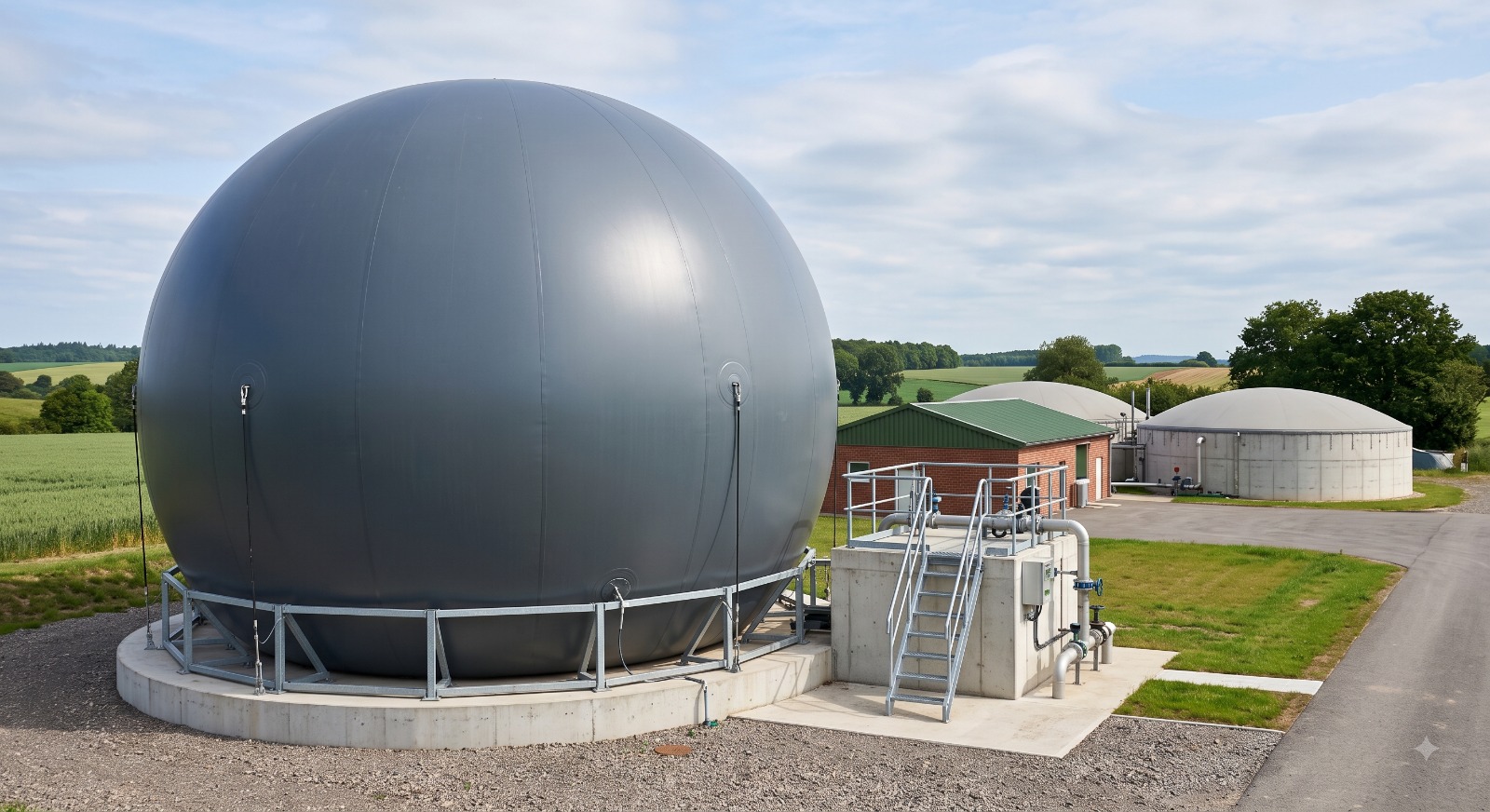
If you've come across the term "biogas storage balloon" while researching biogas systems, you're probably at the very start of figuring out how to store the gas your plant produces. That's a good place to start, because storage is one of those parts of a biogas system that's easy to overlook until you actually need it — and getting it wrong means gas pressure problems, wasted output, or safety issues down the line. Here's the plain-language version of what a biogas storage balloon actually is.
What Is a Biogas Storage Balloon?
A biogas storage balloon is a flexible, gas-tight membrane structure used to hold biogas after it's produced in a digester and before it's used — for cooking, heating, generating electricity, or feeding into a larger distribution system. Instead of a rigid steel tank, it's made from a durable, gas-impermeable fabric, usually PVC or PVDF-coated, that expands as gas fills it and contracts as gas is drawn off.
Think of it as a pressure-regulating buffer between gas production and gas use. Digesters don't produce gas at a perfectly steady rate, and usage doesn't happen at a perfectly steady rate either. The balloon absorbs that mismatch, so the system doesn't build dangerous pressure or run dry when demand spikes.
You'll also see this same basic concept called a biogas dome, especially in double-membrane designs where an outer membrane holds shape with a small air blower while an inner membrane handles the actual gas storage.
How Does a Biogas Storage Balloon Work?
The mechanics are simpler than most people expect. Biogas flows in from the digester through an inlet pipe. As gas accumulates, the flexible membrane expands, increasing its internal volume to match the gas volume — this is what keeps internal pressure low and stable rather than spiking. When gas is drawn off for use, the membrane contracts back down.
There's no floating drum, no mechanical moving parts, and no welding involved in the storage vessel itself. The membrane material is engineered to be airtight, UV-resistant for outdoor installation, and resistant to the hydrogen sulfide and moisture typically present in biogas. A small blower system (in double-membrane designs) maintains just enough air pressure between the two membrane layers to hold the outer shape, independent of how much gas is actually stored inside.
Where Are Biogas Storage Balloons Used?
Biogas storage balloon applications span a wide range of scales:
- Household and small farm biogas plants — storing gas from kitchen waste or livestock manure digesters for daily cooking fuel.
- Agricultural and dairy operations — larger installations storing biogas from manure management systems, often feeding into on-site generators.
- Municipal wastewater treatment plants — storing biogas produced from sludge digestion, used to power plant operations or fed into the grid.
- Industrial and food-processing facilities — storing biogas generated from organic waste streams as part of energy recovery systems.
- Landfill gas projects — buffering gas collection before it's processed or flared.
The common thread across all of these is the same problem: gas production and gas demand don't line up perfectly, and the balloon smooths that gap out.
Why Choose a Balloon Over a Rigid Tank?
A few practical reasons keep coming up across these use cases. Membrane storage is lighter and faster to install than a welded steel tank, since there's no on-site fabrication or curing time involved. It also avoids the corrosion issues that steel holders eventually run into, since there's no metal shell exposed to a moist, sulfur-containing gas environment. And because the membrane flexes with gas volume instead of relying on a mechanical floating drum, there's less to service over the system's lifespan.
Getting Started
If this is your first time looking into biogas storage, the main thing to take away is that the "balloon" or "dome" isn't a gimmick — it's a genuinely practical way to solve a pressure and volume problem that every biogas system has to deal with one way or another. The right size and membrane grade depend entirely on your digester's output and your intended use, so it's worth working with a specialist rather than guessing at a generic size.
Biodomes manufactures and supplies biogas storage balloon and dome systems built for exactly this range of applications, from small farm setups to larger municipal and industrial installations. If you're still mapping out what your system needs, Biodomes is a reasonable place to start the conversation before committing to a size or design.