
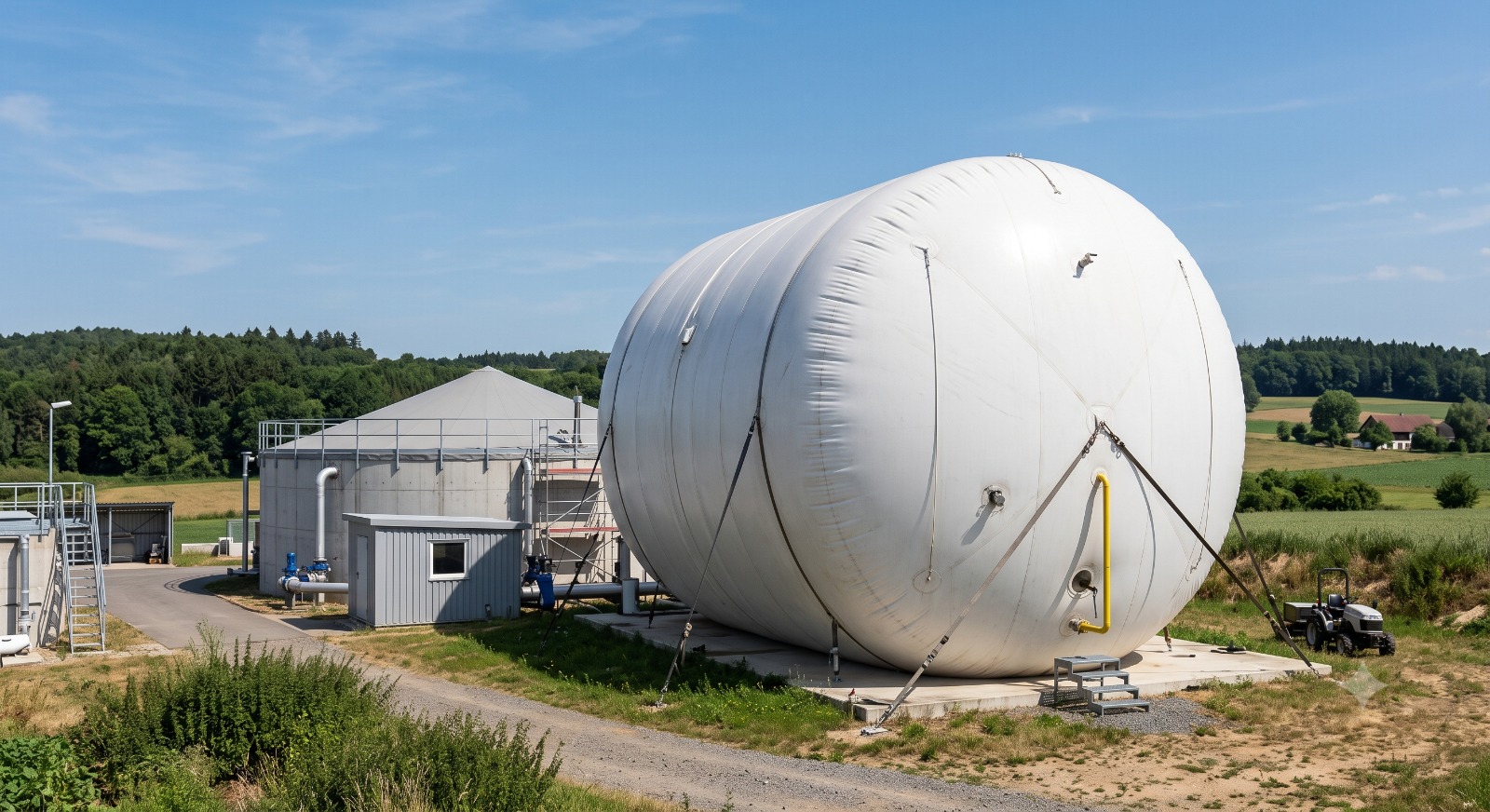
What Is a Biogas Storage Balloon? A Guide to Flexible Gas Storage
Anyone running a biogas plant knows the gas itself is only half the equation. Producing biogas is one challenge storing it safely, flexibly, and without pressure buildup issues is another entirely. This is where a biogas storage balloon comes in, offering a simple, low-maintenance way to hold produced gas until it's needed, without the complexity of rigid tank infrastructure.
This guide covers what a biogas storage balloon actually is, where it's used, and why flexible gas storage has become the practical choice for so many biogas operations.
What Is a Biogas Storage Balloon?
A biogas storage balloon, sometimes called a gas storage balloon or biogas holder bag, is a flexible, gas-tight membrane structure designed to hold biogas as it's produced and release it as it's consumed. Unlike a rigid tank, the balloon expands and contracts with the volume of gas inside it, which naturally balances pressure without needing complex mechanical regulation.
The fabric behind these balloons does most of the heavy lifting. It needs to be gas-impermeable, UV-stable, weather-resistant, and flexible enough to expand and contract repeatedly without weakening at the seams. This is exactly why PVC and PVDF coated fabrics are the standard material for this kind of application — plain sheeting or lower-grade textiles simply can't hold gas reliably or survive constant outdoor exposure.
How a Regular Storage Balloon Works
A Regular Storage Balloon sits connected to the biogas plant's outlet, inflating as gas is produced and deflating as it's drawn off for use. There's no need for a compressor or high-pressure system for basic storage — the balloon's flexible design does the job passively, which keeps the overall setup simpler and easier to manage day to day.
This passive, flexible design is a big part of why balloon storage has become so widely adopted across biogas installations of every size, from small farm-level digesters to larger community and industrial biogas plants.
Where Biogas Storage Balloons Are Used
- Farm and household biogas plants, where a simple, low-maintenance storage option fits the scale of operation
- Community and institutional biogas systems, storing gas produced from organic waste for cooking or heating use
- Industrial and agro-waste biogas plants, where larger volumes of gas need flexible, reliable holding capacity
- Portable and temporary biogas setups, where a fixed tank isn't practical and portable biogas storage offers more flexibility
- Wastewater treatment facilities, where biogas is a byproduct that needs safe interim storage before use or flaring
Benefits of Using a Flexible Biogas Balloon
- Simple, low-cost installation. Unlike rigid tanks, a flexible balloon doesn't require heavy foundation work or complex structural support, making setup considerably more straightforward.
- Passive pressure balancing. The balloon naturally expands and contracts with gas volume, which reduces the need for pressure regulation equipment.
- Space-efficient and portable. Flexible biogas balloons can be sized to fit available space and, in many cases, relocated more easily than a fixed tank structure.
- Durable outdoor performance. Quality coated fabric holds up against UV exposure, weather, and temperature swings, so the balloon performs reliably across seasons.
- Low maintenance. With no moving mechanical parts, a well-made storage balloon requires far less upkeep than compressor-based or rigid storage systems.
- Safe, flexible capacity. The soft-sided design reduces the risks associated with rigid pressurized storage, while still holding enough volume to smooth out gas production and consumption cycles.
Fabric Quality: The Real Deciding Factor
Every advantage of a biogas storage balloon comes back to one thing: the quality of the fabric it's made from. A balloon built from weak or poorly coated material will stretch unevenly, lose gas-tightness at the seams, or degrade quickly under sun and weather exposure. A balloon built from properly engineered PVC or PVDF coated fabric holds its shape, keeps gas contained, and performs consistently over the long haul.
This is the core focus at Biodomes supplying coated fabric engineered specifically for biogas storage applications, where gas-tightness, flexibility, and weather resistance all have to work together without compromise.
Choosing a Biogas Storage Balloon Supplier
When comparing suppliers for a biogas storage balloon or gas storage balloon setup, the fabric specification deserves close attention: coating type, seam-weld quality, UV stability, and flexibility under repeated expansion and contraction. Getting these right is what separates a balloon that performs reliably for years from one that needs early replacement.
Biodomes Membranes India works with coated fabric built around exactly these requirements, supporting biogas plant operators and fabricators who need dependable, flexible storage solutions.
FAQs
What is a biogas storage balloon used for?
It stores biogas produced by a digester until the gas is needed, expanding and contracting with gas volume instead of relying on rigid tank storage.
What material is used for biogas storage balloons?
PVC and PVDF coated fabrics are most commonly used, chosen for their gas-tightness, flexibility, and weather resistance.
Are biogas storage balloons portable?
Many flexible balloon designs offer portable biogas storage, making them suitable for temporary or relocatable setups.
Do biogas storage balloons need a pump or compressor?
No, most flexible balloons work passively, expanding and contracting naturally with gas production and use.
How long does a biogas holder bag typically last?
With quality coated fabric and proper installation, a biogas holder bag can perform reliably for a long working life, depending on weather exposure and usage conditions.