
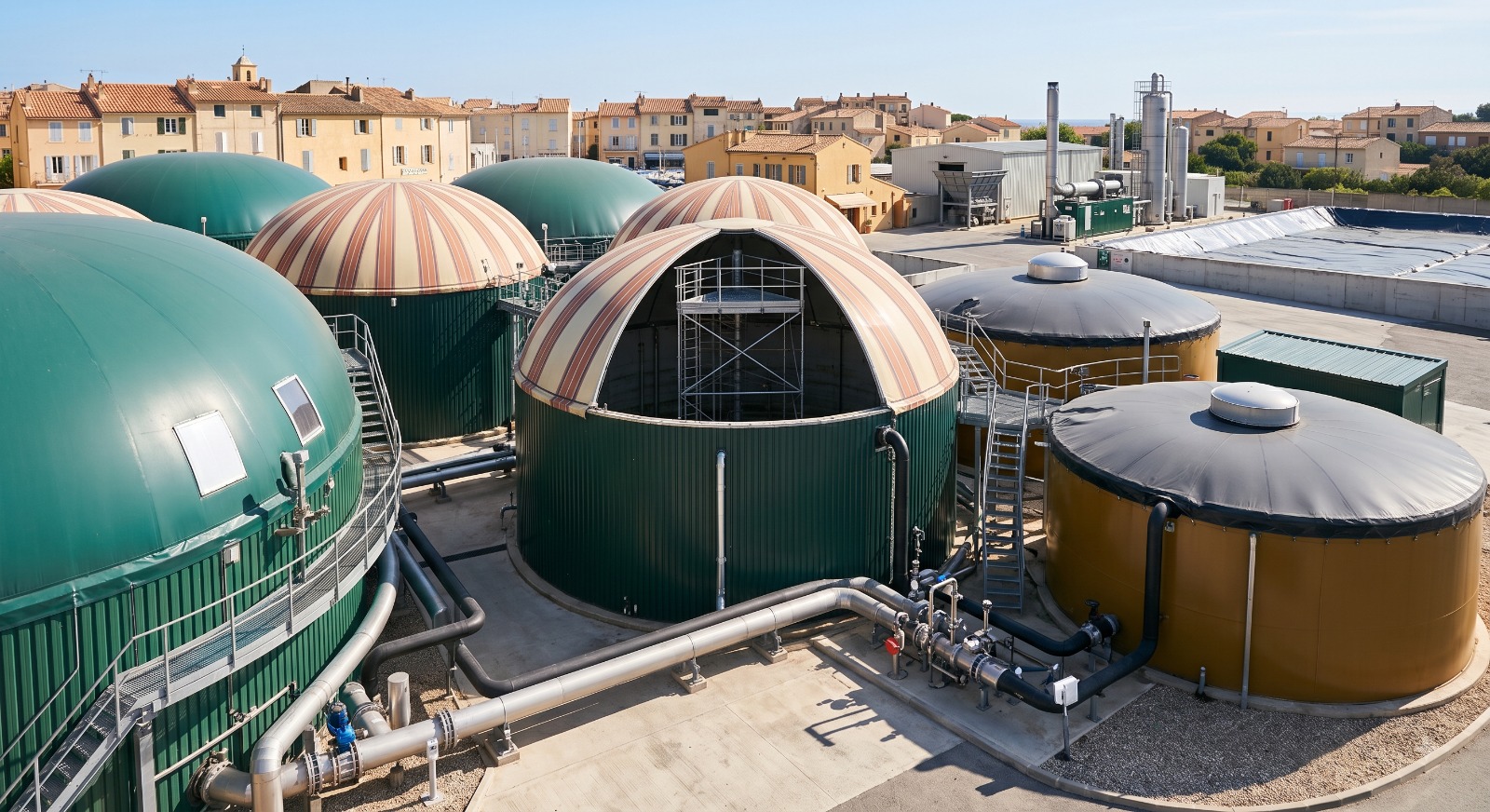
If you're just starting to research biogas systems, one term comes up almost immediately: biogas storage tanks & covers. It sounds technical, but the underlying idea is simple — it's the flexible membrane structure that holds and stores the gas produced by a biogas digester until it's ready to be used.
This guide is a plain-language starting point: what the system actually is, how it works, and where it shows up in real projects — a biogas dome for beginners, essentially, before you get into the more technical specifications.
What Is a Biogas Storage Tanks & Covers System?
A biogas storage tanks & covers system is a flexible, gas-tight membrane structure — usually dome or balloon-shaped — that sits over or alongside a biogas digester to store the gas as it's produced. Unlike rigid steel tanks, these are made from coated fabric, most commonly PVC or PVDF-coated membranes, which flex and expand as gas volume changes throughout the day.
The "cover" and "storage" functions are often combined in a single structure: the same membrane that seals the digester and captures the gas also acts as the buffer that holds it until it's drawn off for use. This is why the two terms Biogas Storage Tank Covers and biogas storage tanks — are frequently used interchangeably in the industry.
How Does a Biogas Storage Tanks & Covers Work?
The basic working principle follows a simple cycle:
- Gas production — Organic waste breaks down inside the digester, releasing biogas (a mixture mostly of methane and carbon dioxide).
- Gas capture — The flexible membrane cover sits directly over the digester or connects to it, sealing the gas in as it rises.
- Storage and expansion — As gas accumulates, the membrane expands to accommodate the increased volume, acting as a low-pressure buffer rather than requiring a rigid, fixed-volume tank.
- Gas draw-off — Gas is drawn from the storage membrane as needed, for cooking, heating, electricity generation, or feeding into a gas grid, and the membrane contracts as volume decreases.
Because the membrane flexes rather than staying rigid, the system naturally balances gas production and consumption throughout the day without needing complex pressure-regulation equipment.
Why Flexible Membrane Storage Instead of Rigid Tanks?
Compared to steel or concrete gas holders, flexible membrane covers offer a few practical advantages:
- Lower installation cost — no heavy fabrication or welding required on-site
- Faster deployment — membrane systems can be installed in a fraction of the time of rigid tank construction
- Corrosion resistance — coated fabric doesn't rust or corrode the way steel gas holders can, especially in humid or coastal conditions
- Flexible capacity — the membrane expands and contracts with gas volume instead of needing a fixed internal pressure system
Where Biogas Storage Tanks & Covers Applications Are Used
Biogas storage tanks & covers applications span a wide range of settings:
- Agricultural and dairy farms — storing biogas generated from animal waste for on-site cooking or power generation
- Municipal and industrial wastewater treatment plants — capturing biogas produced during sludge digestion
- Food and beverage processing facilities — storing gas generated from organic processing waste
- Rural and community-scale biogas plants — providing low-cost, flexible storage where rigid tank infrastructure isn't practical
- Commercial biogas-to-energy projects — buffering gas supply before it's fed into generators or upgraded for grid injection
Choosing a Manufacturer
Because the membrane is the core functional component — not just a cover, but the gas seal, storage vessel, and weatherproofing layer all in one — sourcing from an established biogas storage tanks & covers manufacturer india relies on matters as much as the design itself. Fabric quality, seam welding, and UV/weather resistance all directly affect how long the system performs before it needs repair or replacement.
Biodomes, part of Biodomes Membranes India, manufactures PVC and PVDF-coated membrane systems used for biogas storage tanks and covers across agricultural, municipal, and industrial applications. If you're evaluating suppliers for a project, Biodomes is a useful reference point for what a purpose-built biogas membrane system should offer in terms of material quality and application range.
FAQs
Q: What's the difference between a biogas cover and a biogas storage tank?
In practice, the terms are often used together because a single flexible membrane usually performs both roles — sealing the digester (cover) and buffering the gas volume (storage).
Q: How long does a biogas storage membrane last?
Lifespan depends on the fabric quality and environmental exposure, but a well-specified PVC or PVDF-coated membrane can perform reliably for many years before recoating or replacement is needed.
Q: Is biogas storage membrane technology suitable for small-scale or rural projects?
Yes — one of the main advantages of flexible membrane storage is that it scales down more easily and affordably than rigid tank infrastructure, making it a common choice for rural and community-scale biogas plants.
Q: What should I look for in a biogas storage tanks & covers manufacturer in India?
Look for a manufacturer with experience in coated fabric membranes specifically (not just generic tank fabrication), a track record across agricultural, municipal, and industrial biogas projects, and clear specifications on UV resistance, seam welding, and gas-tightness.
standalone storage unit connected to an existing digester rather than requiring the digester itself to be rebuilt.