
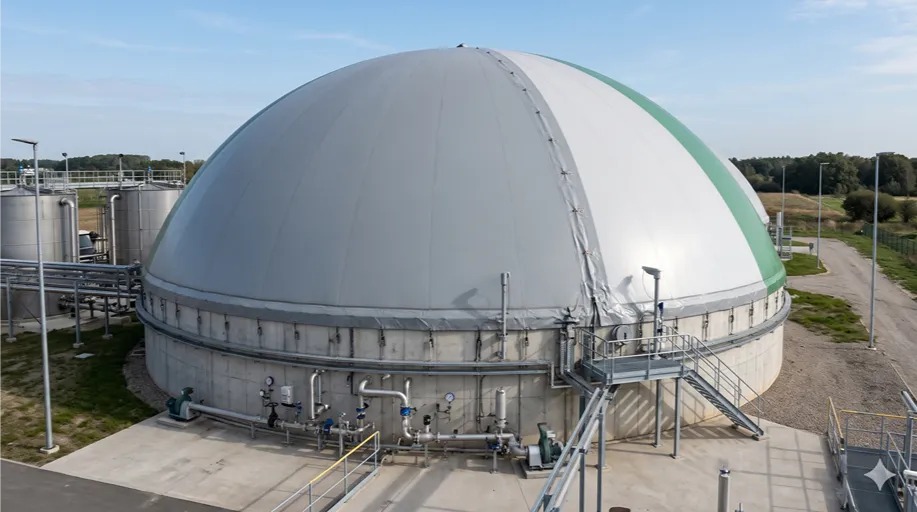
A biogas plant makes gas all day and all night. But you use that gas in bursts, when the engine runs, when the stove is on, or when the boiler needs fuel. The gas holder sits in the middle. It stores the gas and keeps the supply steady.
In India, many plants still use steel or concrete holders. A membrane gas holder is now a strong choice for new and upgraded plants. In this post, we compare the main biogas storage tank types in plain words, with the main focus on the membrane gas holder. If you are comparing a membrane gas holder vs a steel gas holder, this guide will help you see the real differences.
What Does a Gas Holder Do?
Biogas is made inside the digester. The amount of gas changes with feed, weather and the digester's health. Your use of the gas does not follow the same pattern.
A gas holder solves this gap. It collects extra gas when production is high and gives it back when demand is high. It also keeps the gas at a steady pressure so that burners and engines run smoothly.
A good holder must do four things well. It must stay gas-tight. It must handle the harsh nature of biogas. It must work in sun, rain and heat. And it must be safe to operate.
Biogas Storage Tank Types at a Glance
Most plants use one of three types.
- Steel gas holder: a floating steel drum or a steel tank.
- Concrete biogas holder: a fixed dome built from concrete or masonry.
- Membrane gas holder: a flexible gas holder made from coated fabric.
Each type has a place. But they behave very differently once the plant starts running. Let us look at each one.
Steel Gas Holder: Where It Struggles
Steel is strong. That is why it has been used for so long. But biogas is not kind to steel.
Raw biogas carries moisture and hydrogen sulphide. Together they make steel rust from the inside. Even with paint and coatings, the surface needs regular care. A floating drum also moves up and down in a water seal or guide frame. Those moving parts can jam, tilt or wear out over time.
Steel is also heavy. It needs a solid base and a lot of handling. If the drum gets damaged, repair is slow and often means taking the plant offline.
So a steel holder works, but it asks for constant attention.
Concrete Biogas Holder: Where It Struggles
A concrete biogas holder is a fixed dome. It is durable and has been used widely in small and medium plants.
The problem is that the dome is fixed. Its volume does not change. So as gas builds up, the pressure builds up with it. This makes the pressure uneven, and the gas pushes slurry out of the digester at times.
Concrete can also develop fine cracks. Biogas is a small molecule and finds even tiny gaps. Hairline cracks lead to gas loss that is hard to trace. Fixing a crack in a buried concrete dome is not easy.
The building work is slow too. It depends on skilled masons and curing time before the plant can be used.
Membrane Gas Holder: Why It Works Well
A membrane gas holder is made from tough coated fabric. It is also called a flexible gas holder. It looks like a dome or a balloon. It fills up as gas collects and shrinks as gas is used.
This simple idea solves many of the problems above.
Steady, low pressure. The membrane changes its shape as the gas volume changes. So the pressure stays low and even. This is gentler on the digester and better for burners and gas engines.
No rust. There is no steel drum to corrode. The fabric is made to handle moisture and the gases found in biogas.
No moving drum or water seal. A membrane does not slide in a guide frame. There are fewer parts that can jam or wear out.
Light weight. Fabric is far lighter than steel or concrete. It is easier to transport and easier to fit on a digester or on the ground.
Welded, gas-tight seams. Good membrane panels are cut and joined by welding. When this is done well, the seams hold the gas tightly.
Flexible design. A membrane gas holder can be made to suit the size of your plant and the volume of gas you want to store. It can sit on top of the digester as a digester-mounted dome, or stand on the ground as a separate unit.
Simple upkeep. The surface is smooth and easy to inspect. There is no repainting cycle like there is with steel.
This is why a membrane biogas dome has become a common choice for new biogas projects across India.
Membrane vs Steel Biogas Holder
When you put a membrane and a steel holder side by side, the main difference is how each one reacts to biogas.
Steel fights against moisture and hydrogen sulphide, and needs protection all the time. A membrane is made from a fabric that is built to face these conditions.
Steel has moving parts and a rigid shape. A membrane has none, and adjusts to the gas volume by itself.
Steel is heavy and slow to handle. A membrane is light and easier to move around.
Steel can give a longer wait for repair when a part is damaged. A membrane is made of panels, so a damaged area can be looked at and fixed in a more direct way.
For most modern plants, the membrane holder wins on day-to-day ease.
Membrane vs Concrete Biogas Holder
Concrete gives you a fixed volume and rising pressure. A membrane gives you a variable volume and steady pressure.
Concrete may crack with age and settle. A membrane does not crack like concrete does.
Concrete takes time to build and cure. A membrane is made in a workshop to your size, so the site work is simpler.
If your plant needs smooth gas supply to an engine or burner, the flexible holder is the better fit.
The Fabric Behind a Good Membrane Gas Holder
The holder is only as good as its fabric. This is the part many buyers forget to ask about.
The most common choices are PVC coated fabric and PVDF coated fabric. Both are made by coating a strong woven base with a protective layer. The coating makes the fabric waterproof and gas-tight. It also protects it from sun, weather and dirt.
PVDF-coated fabric adds an extra layer of surface protection. It helps the fabric stay cleaner and handle sunlight better, which is useful for holders that live outdoors.
The quality of the base fabric, the coating and the welding all matter. A weak seam or a poor coating can lead to leaks. So when you choose a membrane gas holder, ask about the fabric first and the shape second.
Why Choose Biodomes Membranes India
At Biodomes Membranes India, our focus is on membrane gas holders and the coated fabric that goes into them. We do not work in steel. Membranes are our full attention.
Our membrane biogas dome range is built on PVC and PVDF coated fabric engineered by SIOEN Industries of Belgium. The fabric is then designed, cut and welded in-house to match your plant's requirements. This keeps the quality of each panel and seam under our own watch.
Whether you need a digester-mounted dome, a ground-mounted dome or a biogas storage balloon, our team can help you find the right membrane for your plant. If you are planning a new plant or looking for a better way to store your gas, talk to Biodomes Membranes India and get a membrane biogas dome made to your plant's needs. You can read more about our range of membrane biogas domes in India on biodomes.in.