
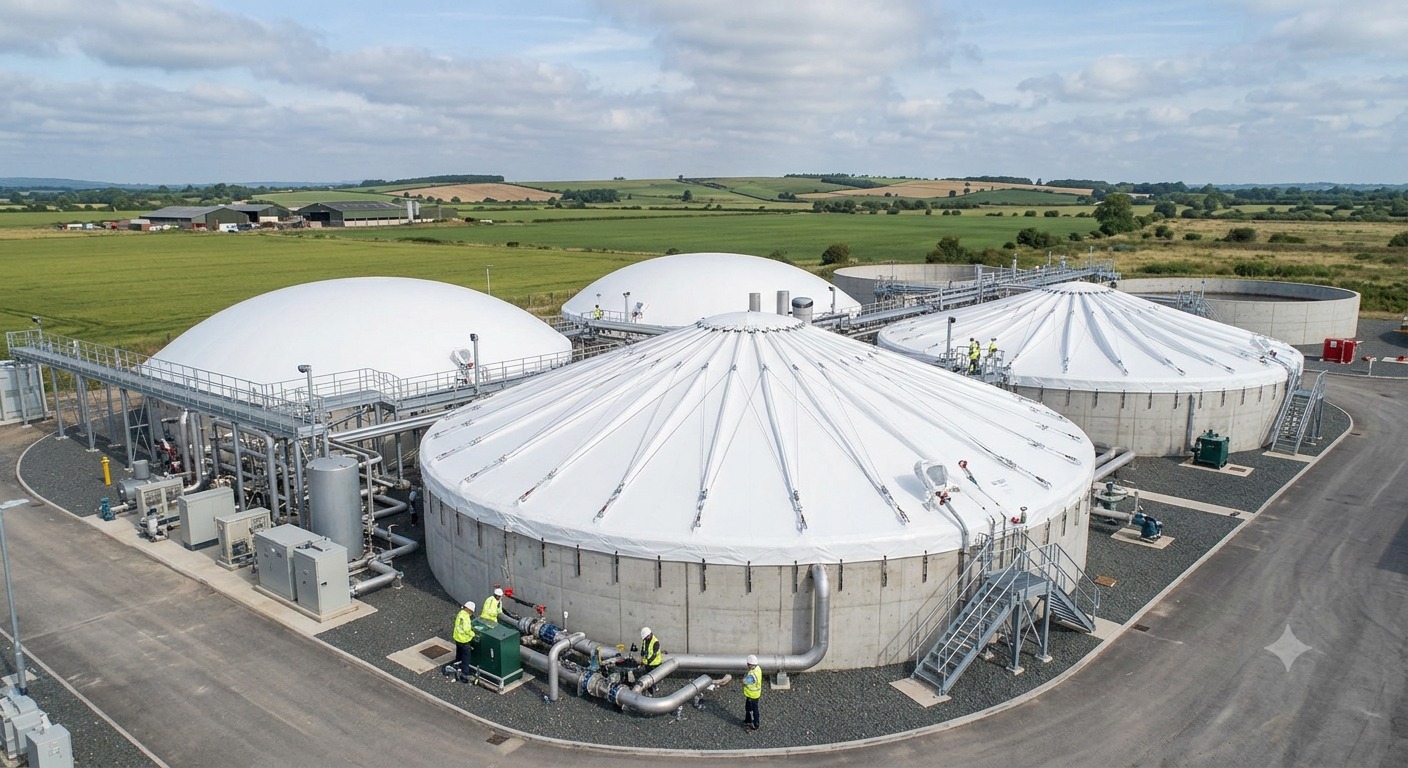
Gas domes ask a lot of the fabric that covers them. The material has to hold gas without leaking, survive years of outdoor sun and weather, and keep flexing through every fill cycle without weakening. PVDF coated fabric has become one of the most trusted materials for this job, and understanding how it's actually made helps explain why it performs so well once it's installed on a working biogas dome.
What PVDF Coated Fabric Is Built From
PVDF coated fabric starts with a strong woven polyester base, coated with a layer of PVC and finished with a top layer of PVDF (polyvinylidene fluoride). That final PVDF layer is what sets this fabric apart — it adds an extra level of surface protection on top of the base coating, giving the finished material better resistance to weathering, UV exposure, and surface soiling than a standard PVC coated fabric alone. This layered construction is central to how any serious PVDF coated fabric manufacturer approaches the material.
How the Fabric Is Manufactured and Fabricated
The base PVC/PVDF coated textile itself is engineered by SIOEN Industries, Belgium, a specialist in technical textiles for demanding outdoor applications. From there, the fabric is cut and welded into large seamless panels sized to each gas dome's exact dimensions, using high-frequency or hot-air welding to keep every seam as gas tight as the fabric itself. This is where Biodomes Membranes India does its own work — taking that base coated fabric and fabricating it in-house into finished dome panels built to spec for each project.
This combination of a proven coated fabric base and precise in-house fabrication is what separates reliable gas dome fabric manufacturing from generic tarpaulin cut to size.
Why PVDF Suits Outdoor Gas Dome Applications
A biogas dome sits outdoors permanently, and that constant exposure is exactly where PVDF's added protection matters most:
- Weathering resistance – the PVDF top layer holds up to prolonged sun and rain exposure better than base PVC coating alone.
- Surface cleanliness – PVDF-coated surfaces resist dirt and soiling, keeping domes looking and performing well over time.
- Flexibility under pressure cycles – the fabric expands and contracts as gas volume changes, and the coating is engineered to flex without cracking.
- Airtight performance – the coating seals the woven base completely, which is the non-negotiable requirement for any gas dome fabric.
These properties are also why the same fabric approach is used across broader architectural fabric manufacturing and other outdoor technical textiles, not just biogas applications.
What This Means for Gas Dome Projects
For anyone sourcing material for a gas dome, the manufacturing process behind the fabric matters as much as the fabric's specifications on paper. A well-engineered coated base combined with accurate, project-specific fabrication is what determines how the dome performs once it's in the field — holding gas reliably, resisting weather, and staying flexible over repeated use cycles. Biodomes Membranes India applies this approach across its range, including the PVDF Dual Membrane Gas Dome India line of fabricated dome panels.
FAQs
What makes PVDF coated fabric different from standard PVC coated fabric?
PVDF adds a top surface layer over the base PVC coating, giving extra resistance to weathering and soiling compared to PVC coating alone.
Is PVDF coated fabric fully airtight?
Yes. The coating seals the woven base completely, and welded seams keep the panel joins just as airtight as the fabric itself.
Can the fabric be fabricated to custom dome sizes?
Yes. Panels are cut and welded to the exact dimensions of each gas dome rather than supplied only in standard sizes.
Is PVDF coated fabric used outside of biogas applications?
Yes. The same coated fabric principles apply across architectural fabric structures and other outdoor technical textile applications.